Master of the Lamps Deep cut
Commodore 64 · Music & Rhythm
Deep cut
| System | Commodore 64 |
|---|---|
| Released | 1983 |
| Genre | Music & Rhythm |
| Players | 1 player |
| Commitment | Quick session (Under an hour, or endless arcade fun) |
| Legacy | Deep cut · legacy score 1 |
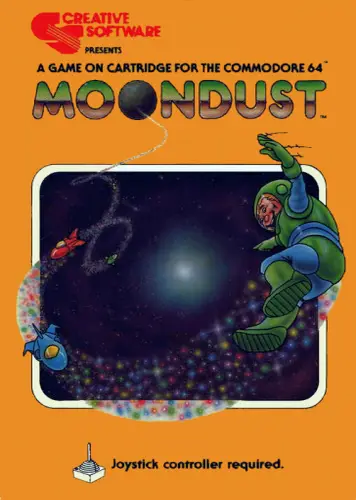
Released for the Commodore 64 in 1983, Moondust is a rhythm game.
It came out in the C64's second year on the market. Other notable C64 releases from 1983 include Attack of the Mutant Camels, Defender and Aztec Challenge.
Moondust is a single-player game, so it's one to enjoy at your own pace.
Music and rhythm games challenge your timing by asking you to hit inputs in sync with the beat.
Tip for newcomers: Modern TVs can add input lag that throws off timing; use your TV's game mode if rhythm feels off.
Stuck, or want to go deeper? These trusted sites have full walkthroughs, completion times and more for Moondust.


C64 games loaded from cassette or floppy disk, and many reward patience and practice. The THEC64 reissues make original-style play easy on modern TVs, and Rec0m88 supports the C64 if you own your games.
Moondust was released for the Commodore 64 in 1983.
No. Moondust is a single-player game.
As a rhythm game, Moondust typically falls into the "Quick session" category: under an hour, or endless arcade fun. Your time will vary with skill and how much you explore.
Read more about Moondust on Wikipedia. Facts on this page are compiled from the open libretro database and Wikidata; "legacy score" reflects how widely a game is documented across Wikipedia's language editions. Spotted an error? Let us know.